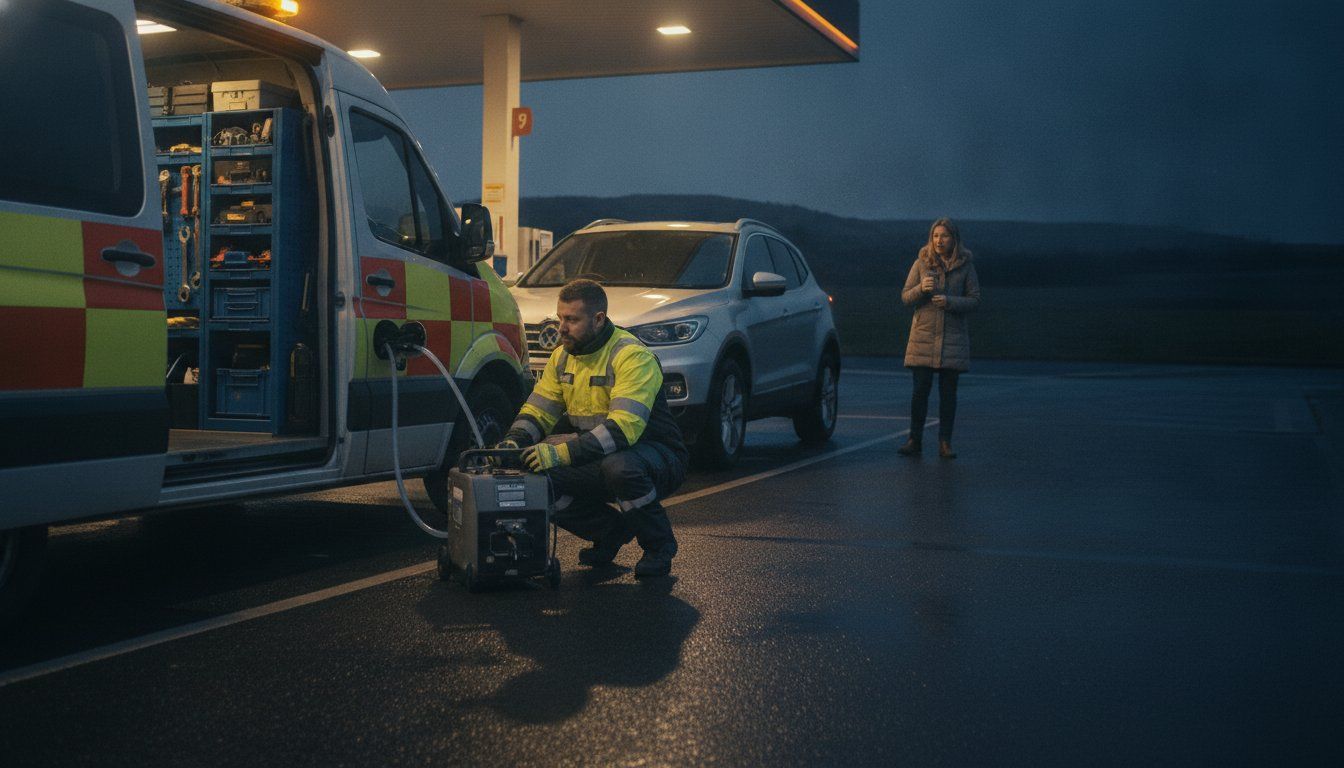
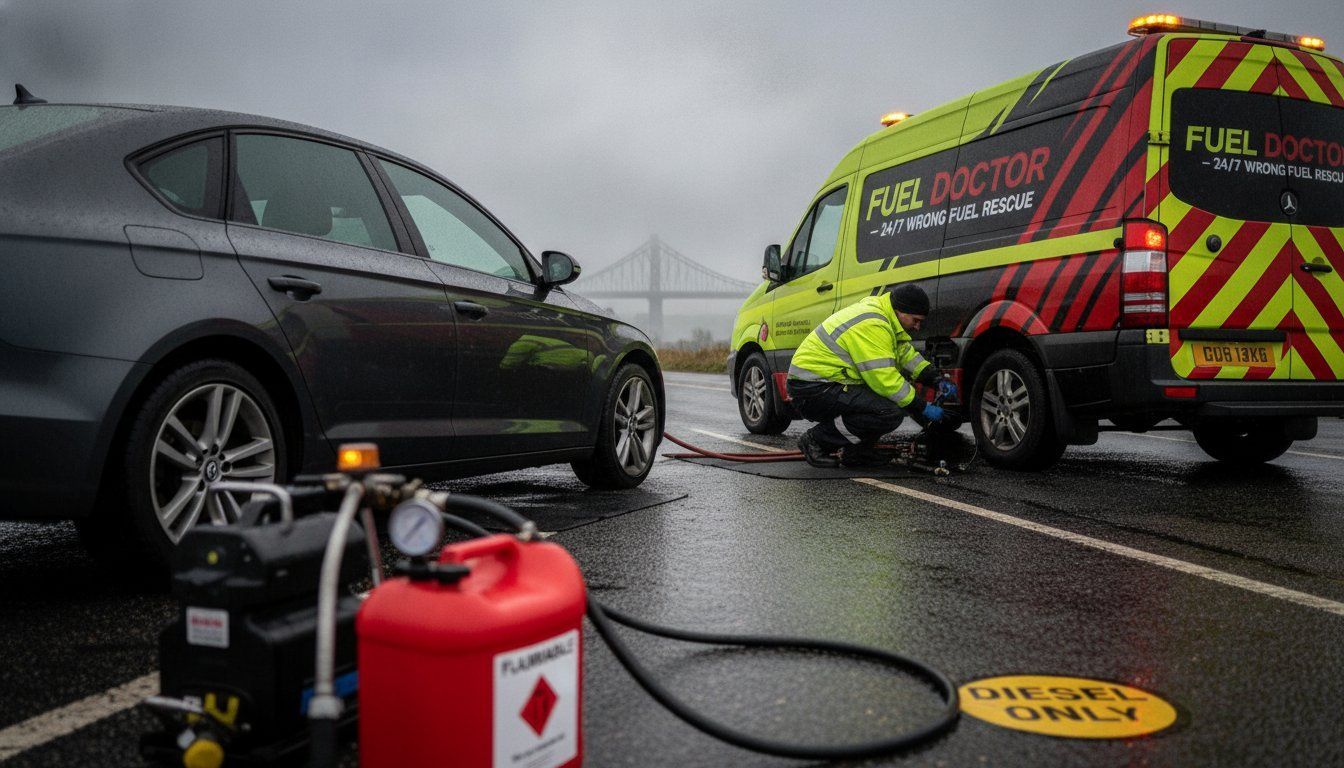
Have you just looked down at the pump and realised the unthinkable has happened? Finding adblue in diesel tank reservoirs is an instant recipe for panic, and for good reason. It’s a corrosive, water-based solution that can crystallise inside your fuel system, potentially leading to a total engine write-off if handled incorrectly. You are likely staring at your dashboard right now, worrying about a massive repair bill or wondering if you will be stranded at the roadside for hours.
It is a stressful situation, but your engine is not lost yet. This guide outlines the immediate, life-saving steps you must take right now to protect your vehicle and avoid the "doom and gloom" quotes often handed out by main dealerships. We will explain why you must keep the ignition off, how mobile specialists can drain and flush your system on-site, and the reality of what this mistake actually costs to fix compared to a full engine replacement. From Newcastle to Middlesbrough, we provide the technical expertise needed to get you back on the road without the need for an expensive tow.
Key Takeaways
- Don't turn the key or put it in the ignition; modern cars often prime the fuel pump automatically, which can pull the solution into your engine instantly.
- Learn why the water-based chemistry of AdBlue is so destructive to non-ferrous metals like copper and aluminium within your fuel system.
- Discover how a professional on-site decontamination can save your engine and avoid the massive costs associated with "replace everything" dealership policies.
- Find out how to handle an adblue in diesel tank emergency with 24/7 rapid response coverage across Newcastle, Sunderland, and Middlesbrough.
Table of Contents
What is AdBlue and why is it dangerous in a diesel tank?
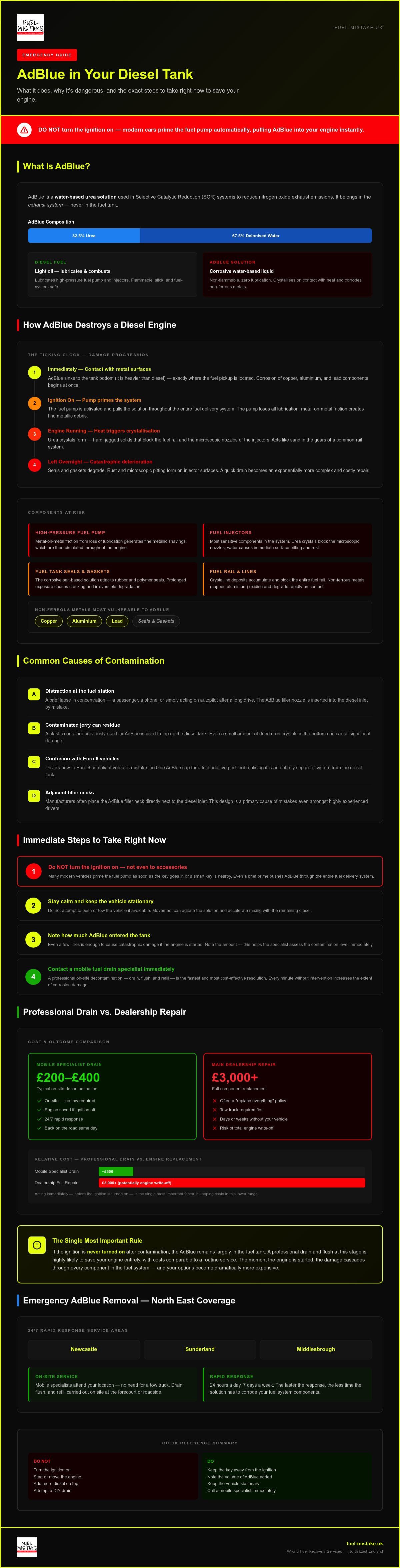
AdBlue is a clear liquid solution consisting of 32.5% high-purity urea and 67.5% deionised water. It is a fundamental part of the Selective Catalytic Reduction (SCR) system, designed to reduce nitrogen oxide emissions by being sprayed directly into the exhaust flow. While maintaining these systems is essential for vehicle emissions compliance, as noted by Smog Plus Service, AdBlue is not a fuel additive. It should never enter the combustion chamber or the fuel delivery system. When you find adblue in diesel tank compartments, you have introduced a substance that is chemically incompatible with your engine's internal workings. Whilst diesel is an oil that provides essential lubrication, AdBlue is a water-based corrosive that begins to crystallise the moment it is exposed to air or heat.
The difference between AdBlue and diesel fuel
Diesel fuel is essentially a light oil. Beyond providing power, it serves as a critical lubricant for the high-pressure fuel pump and the microscopic components within your fuel injectors. These parts operate under immense pressure and rely on the "slickness" of diesel to prevent wear. AdBlue, being water-based, offers no such protection. If it enters the fuel lines, the lubrication stops, and metal components begin to grind against one another. Because AdBlue is non-flammable, it will not ignite under the high compression of a diesel engine. Instead, it will cause the vehicle to sputter, lose power, or seize entirely. Manufacturers often place the AdBlue filler neck directly next to the diesel inlet, which is a primary reason why these mistakes are so common amongst even the most experienced drivers.
Common ways AdBlue contamination occurs
Most incidents occur during a brief lapse in concentration at the petrol station. You might be distracted by a passenger or simply acting on autopilot after a long day, leading you to insert the AdBlue nozzle into the diesel tank. However, contamination isn't always that direct. We frequently attend call-outs where a driver has used a plastic jerry can previously used for AdBlue to top up their diesel. Even a small amount of residue or dried urea crystals in the bottom of a container can cause havoc. There is also a significant amount of confusion amongst owners who are new to Euro 6 compliant vehicles. They may see the blue cap and assume it is a port for a performance-enhancing additive rather than a separate system entirely.
Even a few litres of this solution can lead to a catastrophic mechanical failure if the ignition is turned on. Once the pump primes, the AdBlue is pulled through the entire system, leaving a trail of corrosion and crystalline deposits in its wake. This is why immediate professional intervention is the only way to safeguard your vehicle's future.
The chemistry of damage: How AdBlue destroys diesel engines
Understanding the chemical makeup of AdBlue is vital to grasping why it is so much more destructive than simply putting the wrong fuel in your car. Unlike petrol, which is still a solvent, AdBlue is a salt-based solution that is aggressively corrosive to non-ferrous metals. Components made from copper, lead, and aluminium are particularly vulnerable. When you have adblue in diesel tank systems, these metals begin to oxidise and degrade almost immediately. This isn't just surface-level grime; it is a chemical attack on the precision-engineered internals of your engine.
The water content in the solution introduces another layer of danger. Diesel engines rely on extremely tight tolerances, and the presence of water causes immediate rust and microscopic pitting on the surface of fuel injectors. Once the engine is started and the system heats up, the urea in the AdBlue undergoes a phase change. It crystallises into hard, jagged solids that can block the entire fuel rail and the microscopic nozzles of the injectors. AdBlue crystals act like 'sand in the gears' for common-rail systems.
The 'Ticking Clock': Why time is of the essence
Corrosion begins the moment the solution touches the metal surfaces of your tank and pump. Because AdBlue is heavier than diesel, gravity pulls it to the bottom of the fuel tank. This is exactly where the fuel pickup is located. If you leave the car overnight, the solution has more time to settle and begin eating away at the seals and gaskets. A quick drain becomes significantly more complex and expensive the longer the contamination is allowed to sit. If you suspect a mistake, contacting a specialist for an immediate flush is the most effective way to limit the damage.
Component failure list
- High-pressure fuel pump: Without the lubricating properties of diesel, the pump's internal components suffer from metal-on-metal friction. This leads to the creation of fine metal shavings that are then pumped through the rest of the engine.
- Fuel injectors: These are the most sensitive parts of the system. Urea crystals can cause 'pintle' damage or complete blockages, leading to misfires or a total engine seizure.
- Fuel lines and filters: AdBlue can permeate the entire fuel delivery network. A standard filter change isn't enough; the lines require a complete chemical flush to ensure no salt residue remains to cause future issues.
Immediate steps: What to do right now
The moment you realise there is adblue in diesel tank reservoirs, you must stop everything. Do not start the engine. This is the single most important rule to follow, as ignition is the threshold between a simple tank drain and a multi-thousand-pound mechanical disaster. In modern vehicles, simply putting the key in the ignition or pressing the "start" button to accessory mode can be enough to trigger the fuel pump. This primes the system, pulling the corrosive solution out of the tank and into the fuel lines. Remove the key entirely and place it in your pocket or the centre console to ensure no one accidentally attempts to start the car.
Once the car is immobilised, alert the petrol station staff. They deal with misfuelling incidents regularly and can help you manage the situation safely. They may be able to provide "out of use" signs for the pump and assist in moving your vehicle away from the forecourt to a safer location.
Safety and logistics at the petrol station
If it is safe to do so, put the car in neutral and push it to a designated parking bay. This clears the pump for other customers and gives a mobile technician a safe space to work. Never attempt to "dilute" the AdBlue by filling the rest of the tank with diesel. Because AdBlue is water-based and heavier than fuel, it will not mix; it will simply sit at the bottom, ready to be sucked into the engine. Ensure you keep your fuel receipt, as it provides a precise record of the volume of adblue in diesel tank systems, which helps the technician determine the best flushing strategy.
Assessing the situation
Your next move depends on whether the engine has been running. If you haven't started the car, the fix is straightforward and relatively low-cost. If the engine has been started, even for a few seconds, the urea solution has likely reached the injectors, and the complexity of the repair increases significantly. Check your surroundings and ensure you are in a location where a service vehicle can reach you easily. If you are stranded in the North East, Fuel Mistake® provides 24/7 emergency help to drain the contamination on-site, preventing the need for an expensive tow to a garage.
Professional drain vs. Dealership repairs: Comparing costs
When you call a main dealer to report adblue in diesel tank contamination, the response is often a quote that makes your heart sink. It isn't uncommon for prestige brands to suggest repairs exceeding £10,000. This "doom and gloom" approach isn't always because the engine is ruined; it's because dealerships prioritise absolute liability removal over cost-effective restoration. A mobile specialist uses targeted decontamination techniques to achieve a safe, reliable result at a fraction of that price. By choosing an on-site fix, you also eliminate the immediate need for expensive recovery trucks and the daily storage fees associated with traditional garages.
Why dealerships quote £10,000+
Main dealers rarely attempt to clean a fuel system once it has been contaminated. Instead, their internal protocols often mandate the total replacement of every component the AdBlue might have touched. This includes the fuel tank, the high-pressure pump, the common rail, and all fuel injectors. When you combine the cost of these brand-new parts with high hourly labour rates for "prestige" technicians, the bill spirals. They choose this path to guarantee their work 100%, but it often results in the customer paying for an entire new system when a thorough flush would have sufficed.
The mobile specialist approach
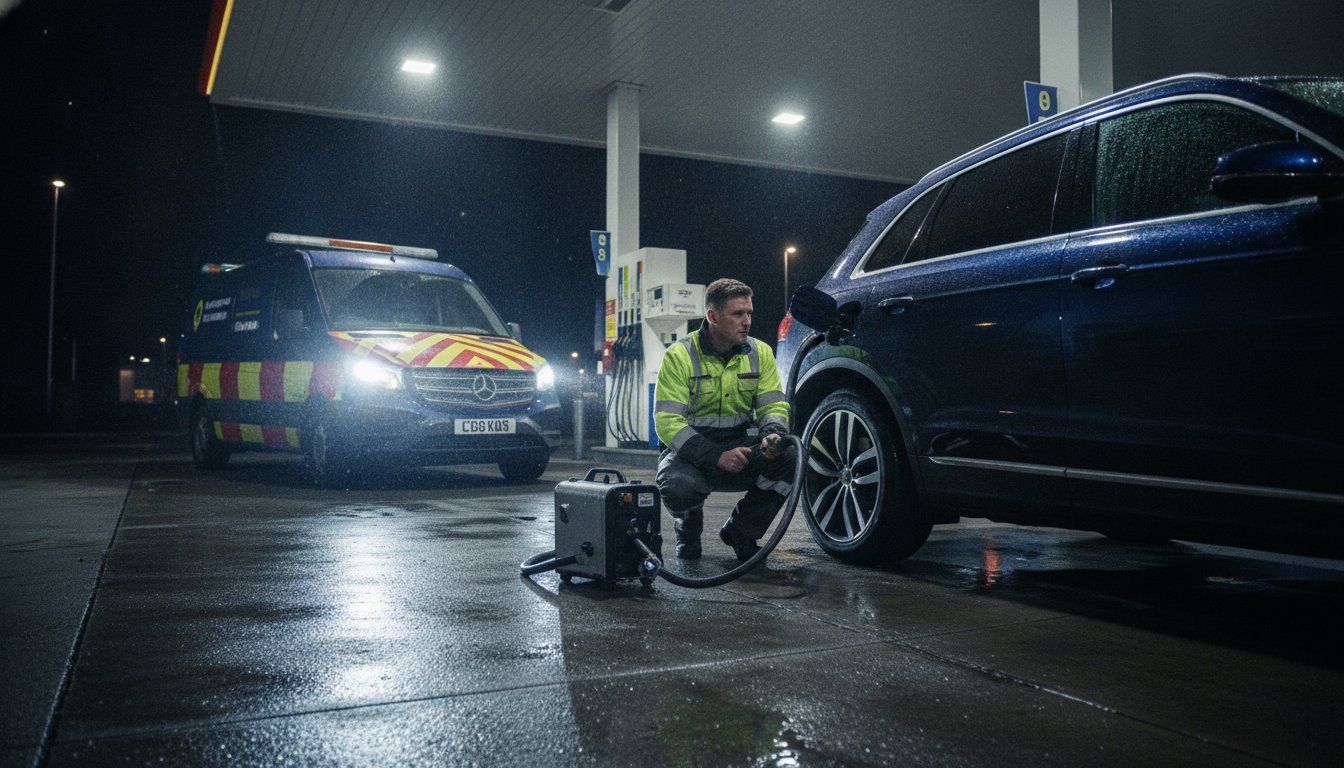
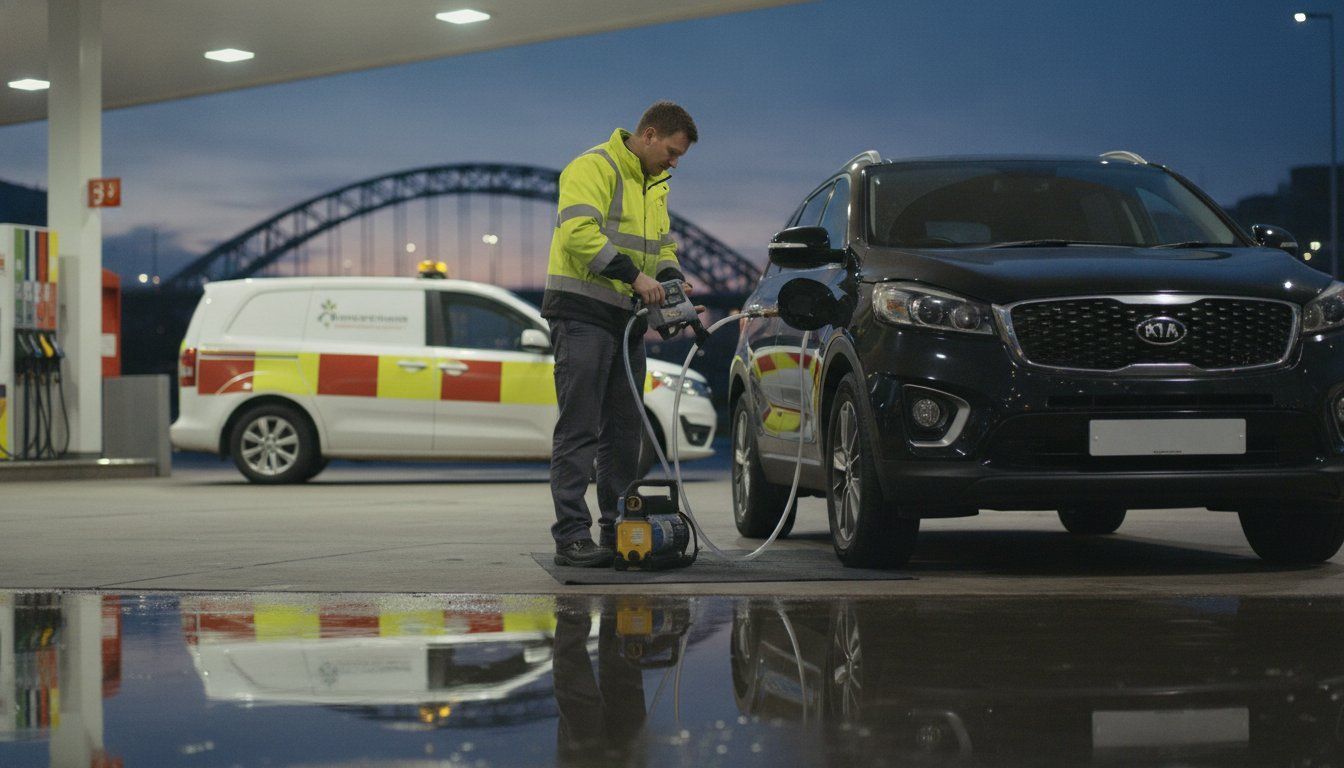
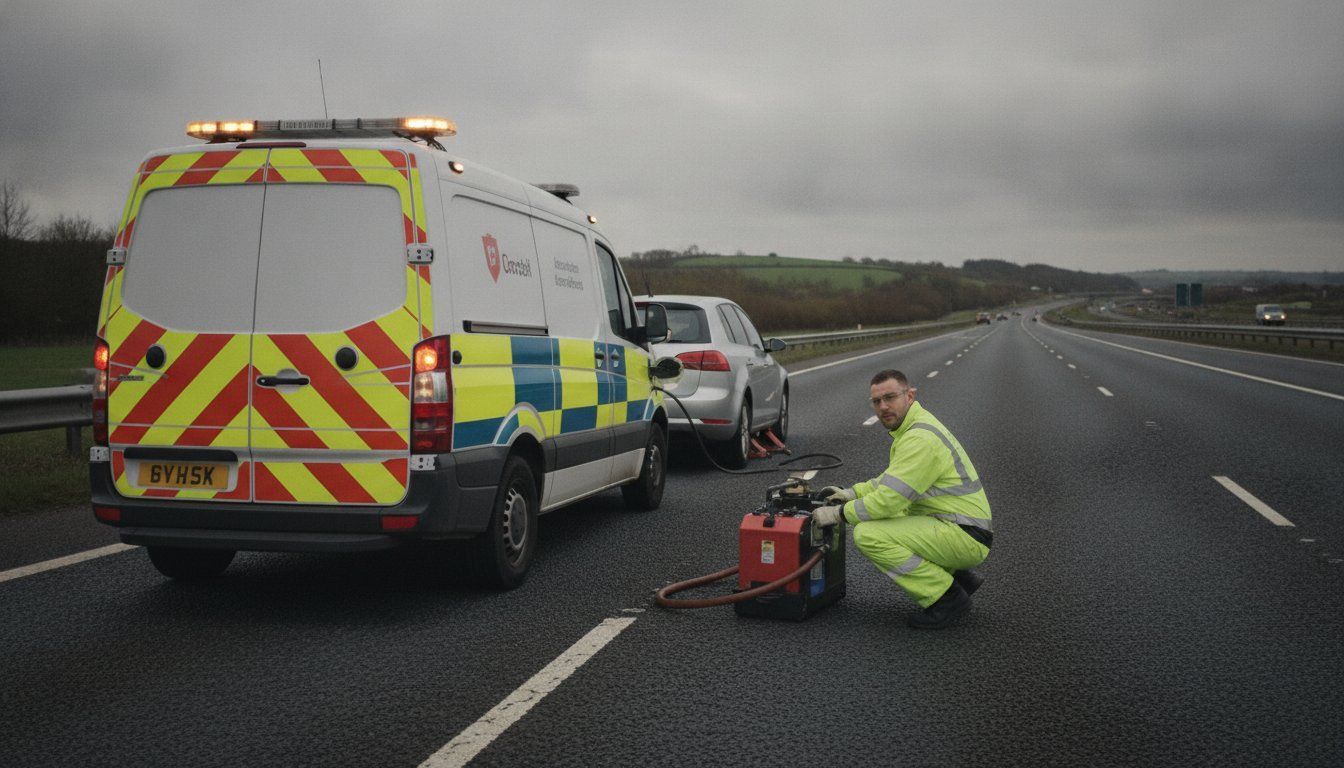
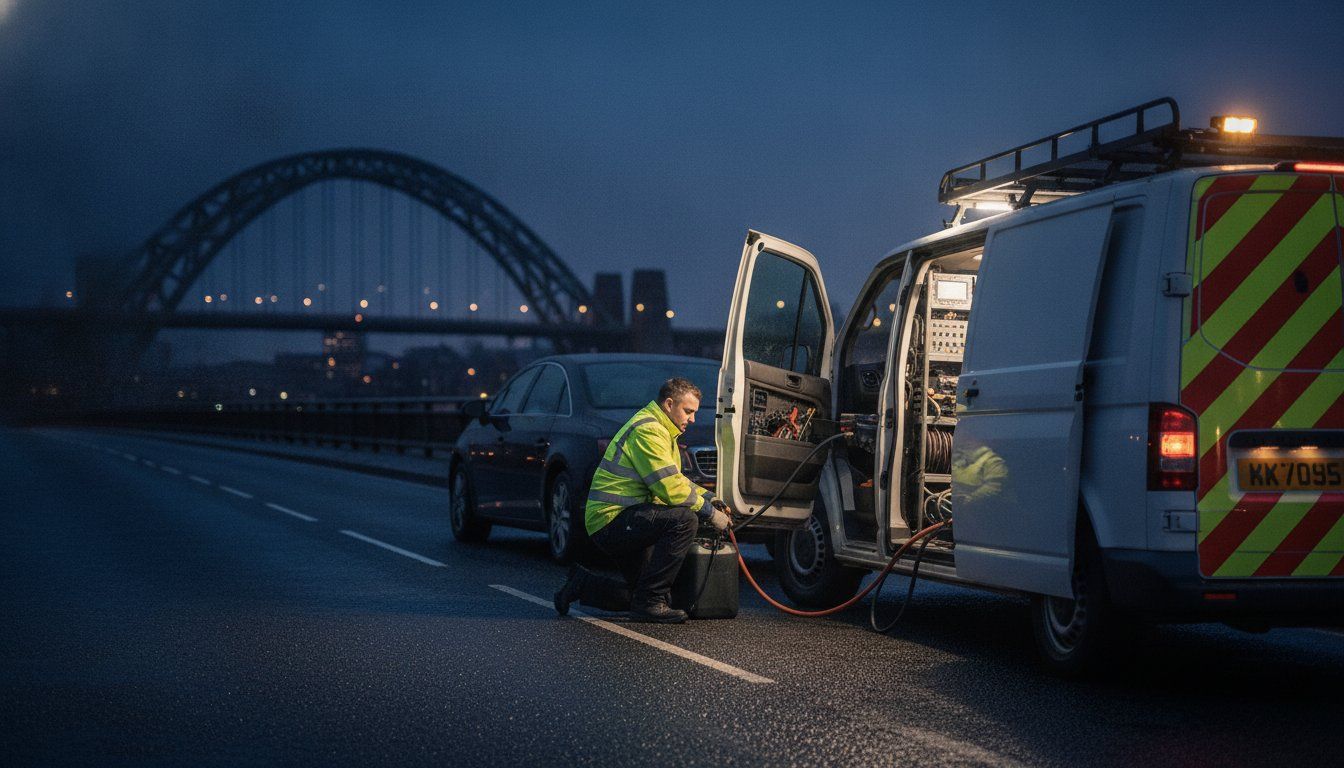
A specialist fuel drain service takes a more surgical approach to the problem. We use high-power suction equipment specifically designed to extract every drop of the urea solution from the tank. Once the bulk of the adblue in diesel tank mixture is gone, we perform a system-wide flush using fresh diesel to neutralise and remove any remaining crystalline residue. Most mobile drains are completed in 1 to 3 hours, whilst a garage might keep your car for days or even weeks. We also replace the fuel filter as standard and perform a diagnostic check to ensure the fuel pressure is correct before you drive away.
If you want to avoid dealership prices and get back on the road today, book an emergency fuel drain with a technician who understands the chemistry of the fix.
Emergency AdBlue removal in the North East
Finding yourself with adblue in diesel tank contamination is an emergency that many national recovery services simply aren't equipped to handle. Whilst general breakdown providers are helpful for standard mechanical failures, they often refuse to perform on-site AdBlue drains because the process requires specialist decontamination equipment and specific training. Fuel Mistake® fills this vital gap. We provide a 24/7 lifeline across the North East, combining three generations of motor industry experience with the technical precision required for modern Euro 6 engines. Our family-run team understands the panic of misfuelling, and we've built our reputation on being the dependable neighbour who also happens to have prestige dealership training.
We don't treat this as a standard recovery job. Because AdBlue is a corrosive pollutant, it requires careful handling and certified disposal. Our technicians arrive with the specific tools needed to neutralise urea crystals before they can settle into the sensitive crevices of your fuel system. We take pride in our credentials and our deep roots within the community, ensuring that every customer receives professional, safety-first service that protects their vehicle warranty and their pocket.
Local coverage and response times
Our mobile units are strategically positioned to serve Newcastle, Sunderland, and Middlesbrough around the clock. We also provide full coverage for Durham, Darlington, Hartlepool, and Stockton-on-Tees. Because we focus exclusively on fuel mistakes, our response is typically faster and more focused than a general garage or a multi-purpose recovery service. You can usually expect a technician to arrive at your location within 60 to 90 minutes. Whether you are stuck on a busy petrol station forecourt, at your home, or in a workplace car park, we bring the solution directly to you, avoiding the need for an expensive tow.
Why choose Fuel Mistake® for AdBlue errors?
General recovery services often lack the high-power suction and chemical flushing agents needed to fully neutralise urea residue. We don't just drain the tank; we ensure the entire fuel delivery network is safe. To help you understand the broader risks of fuel errors, see our Misfuelling Guide for more on engine safety. We also believe in absolute transparency, which is why we provide clear, fixed-price quotes before any work starts. There are no hidden fees for "emergency" call-outs or late-night arrivals. If you want to see how we handle these high-stakes situations in your area, read our Newcastle Case Study to see us in action. We are here to turn a potentially catastrophic mistake into a manageable local fix.
Protect Your Engine and Save on Costly Repairs
Putting adblue in diesel tank reservoirs doesn't have to result in a total mechanical write-off. By keeping the ignition off and avoiding the temptation to start the engine, you have already taken the most important step toward a successful recovery. You now understand that whilst dealerships may quote astronomical prices for total system replacements, a professional on-site flush is a faster, more affordable alternative that protects your vehicle and your peace of mind.
Our family-run team of specialist technicians is ready to help with a fixed price guarantee. We provide a 24/7 mobile service across Newcastle, Middlesbrough, and the wider North East, ensuring you aren't left stranded with a massive repair bill. Don't let a momentary lapse at the pump turn into a permanent problem. Call Fuel Mistake® Now for 24/7 Emergency AdBlue Removal and let us get you moving safely again. We are here to help you navigate this emergency with technical expertise and local, dependable service.
Frequently Asked Questions
Can I drive my car if I only put a small amount of AdBlue in the diesel tank?
No, you must not drive the vehicle under any circumstances. Even a tiny amount of AdBlue is a water-based solution that does not mix with diesel fuel. It will settle at the bottom of the tank and be pulled directly into the high-pressure fuel system, where it begins to corrode metal components and crystallise. Driving the car will only accelerate the spread of the contaminant through the engine.
Does standard breakdown cover include AdBlue in the diesel tank?
Most national breakdown providers do not offer on-site adblue in diesel tank decontamination as part of a standard membership. Their typical protocol is to tow your vehicle to a local garage or a main dealership. This often results in higher costs due to recovery fees and the "replace everything" policies that many garages follow. A specialist mobile fuel drain service is usually the only way to get the system flushed at the roadside.
Will insurance pay for an AdBlue in diesel tank mistake?
Whether your insurance covers this error depends entirely on your specific policy wording and whether you have "misfuelling" cover included. Some premium policies will pay for the drain and flush, but you should be aware that claiming may affect your no-claims bonus and involve a high excess. It is often faster and more cost-effective to pay for a specialist mobile drain directly rather than going through a lengthy insurance claim process.
What are the symptoms of AdBlue contamination if I've already started the car?
If you have already started the engine, you will likely experience immediate power loss, a rough idle, or the engine cutting out entirely. You may also see a "check engine" or "fuel system error" light on your dashboard. These symptoms occur because the non-flammable AdBlue is preventing combustion and the urea crystals are beginning to block the fuel injectors. If this happens, pull over safely and turn off the engine immediately.
Is AdBlue corrosive to the fuel tank itself?
Yes, AdBlue is highly corrosive to metal components, particularly those made of copper, aluminium, or non-stainless steel. Whilst many modern fuel tanks are made of plastic, the internal parts like the fuel sender unit, sensors, and the fuel pump housing often contain metals that will react with the solution. Leaving the mixture in your tank for an extended period increases the risk of these parts failing, making a rapid drain essential.
How much does it cost to drain AdBlue from a diesel tank in 2026?
The cost of a professional drain depends on the complexity of the contamination and whether the solution has reached the fuel lines. A specialist on-site drain is significantly cheaper than the quotes provided by main dealerships, which often suggest replacing the entire fuel system. Choosing a mobile service for adblue in diesel tank removal also saves you the expense of a recovery vehicle and the time lost whilst your car sits in a garage queue.
Can AdBlue crystallisation be reversed without replacing parts?
Early-stage crystallisation can often be resolved through a professional chemical flush if the contamination is caught quickly. Specialists use specific cleaning agents to dissolve the urea crystals and neutralise the system. However, if the crystals have been allowed to harden inside the injectors or the high-pressure pump for several days, the damage may become permanent. This is why the "ticking clock" nature of AdBlue contamination requires an immediate response.
What happens if I put diesel in the AdBlue tank instead?
Putting diesel into your AdBlue tank is a separate mechanical issue that requires the AdBlue reservoir to be drained and cleaned before the car is driven. Diesel will destroy the sensitive Selective Catalytic Reduction (SCR) catalyst, which is an extremely expensive component to replace. If you realise you've put diesel in the blue filler cap, do not start the engine, as this will pump the fuel into the exhaust treatment system.